The SCUM Manifesto: A Deep Dive into Valerie Solanas’ Radical Text
The SCUM Manifesto, available as a PDF through various archives and digital resources, ignited controversy upon its 1968 publication.
It details Solanas’ radical vision, advocating for a female-centric society and the dismantling of patriarchal structures, and remains a potent, if divisive, text.
Origins and Historical Context (1967-1968)
The SCUM Manifesto emerged from the turbulent socio-political landscape of 1967-1968, a period marked by burgeoning second-wave feminism, anti-war protests, and widespread countercultural movements. Valerie Solanas began drafting the manifesto in 1967, circulating early versions amongst her radical feminist circles in New York City.

This was a time when traditional gender roles were being fiercely challenged, and women were increasingly vocal about their dissatisfaction with systemic oppression. The availability of the SCUM Manifesto as a PDF today allows modern audiences to understand its immediate context.
Its initial publication in June 1968, via a clipping in the Berkeley Barb, a counterculture newspaper, coincided with heightened political activism. The manifesto wasn’t widely disseminated initially, existing largely within underground networks. The archives show it predated and then was overshadowed by the notoriety surrounding Solanas’ attempted assassination of Andy Warhol later that year, inextricably linking the text to her act of violence and further fueling its controversial reception. The PDF format ensures its continued accessibility, preserving a crucial document of this era.
Valerie Solanas: Life and Influences
Valerie Solanas (1936-2004) was a radical feminist, playwright, and political activist whose life profoundly shaped the SCUM Manifesto. Her early life was marked by trauma and instability, including a difficult relationship with her parents and experiences of sexual assault. These experiences fueled her intense distrust of men and her developing radical ideology.
Solanas’ intellectual influences were diverse, ranging from Marxist theory to Nietzschean philosophy. She developed her own unique brand of feminism, characterized by its extreme misandry and advocacy for female separatism. The SCUM Manifesto, readily available as a PDF, embodies these beliefs.
Before gaining notoriety for shooting Andy Warhol, Solanas was involved in various radical political groups and attempted to establish her own revolutionary movements. Her play, “Up Your Ass,” further showcased her confrontational style. Studying her biography alongside the manifesto – easily accessed through digital archives – reveals the deeply personal roots of her provocative ideas. The PDF format allows for a comprehensive examination of her work and its context.
The Core Tenets of the SCUM Manifesto
The SCUM Manifesto, widely circulated today as a PDF, articulates a fiercely anti-male and pro-female ideology. Its central tenet is the belief that men are the primary oppressors of women and that the patriarchal system must be overthrown. Solanas argues that women are biologically superior to men, possessing greater intelligence and creativity.
The manifesto proposes a radical restructuring of society, advocating for complete automation to eliminate the need for male labor and the abolition of the money system. It calls for the establishment of a female-dominated society where women are free to pursue their own desires without male interference. Accessing the PDF reveals a detailed plan for societal upheaval.
Furthermore, Solanas critiques traditional notions of femininity and encourages women to embrace their sexuality and reject societal expectations. The manifesto’s provocative language and uncompromising stance continue to spark debate. Digital archives provide easy access to this foundational text of radical feminism, allowing for critical analysis of its core arguments.
Defining “SCUM”: Society for Cutting Up Men
The acronym “SCUM,” central to Valerie Solanas’ manifesto – readily available as a PDF online – stands for “Society for Cutting Up Men.” However, Solanas clarifies that “cutting up” is not necessarily literal; it represents a metaphorical dismantling of male power and influence. The manifesto, accessible through digital archives, details this vision.
SCUM, as defined within the text, is envisioned as an organization of women dedicated to overthrowing the patriarchal system. It’s a collective aimed at achieving female liberation through the elimination of male dominance. The PDF version of the manifesto emphasizes that this isn’t about individual hatred, but systemic change.
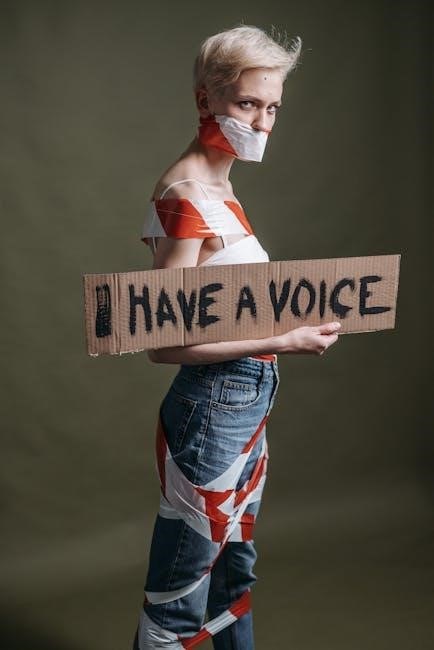
Solanas argues that men, by their very nature, are inherently oppressive and that their existence hinders female progress. The SCUM society, as outlined in the manifesto, seeks to create a world where women can thrive without the constraints imposed by male control. Studying the PDF reveals the depth and complexity of this radical definition.
Key Arguments Against Patriarchy
Valerie Solanas’ SCUM Manifesto, widely circulated as a PDF, presents a scathing critique of patriarchy, arguing it’s a system fundamentally detrimental to women. The text, available in digital archives, asserts that patriarchy isn’t merely a set of oppressive practices, but is ingrained in the very biological and social structures of society.

A core argument within the manifesto – easily examined in its PDF form – is that men control all aspects of life, rendering them irrelevant to women. Solanas contends that women are forced to define themselves in relation to men, perpetuating their subjugation. The PDF highlights her belief that this system breeds boredom and a lack of purpose for women.
Furthermore, the manifesto, accessible as a PDF, criticizes the economic and political systems as inherently male-dominated, designed to benefit men at the expense of women. Solanas advocates for complete automation to eliminate the need for male labor, thus dismantling a key pillar of patriarchal power. The PDF provides a detailed exploration of these interconnected arguments.

The Proposed New Society: A Female-Centric Vision
The SCUM Manifesto, readily available as a PDF, doesn’t simply critique existing structures; it outlines a radical vision for a new society entirely centered around women. Solanas, within the PDF document, proposes a world where women are liberated from the constraints of male dominance and can pursue their own fulfillment.
This female-centric society, detailed in the manifesto’s PDF version, would be characterized by the elimination of money and government, replaced by complete automation. This automation, according to Solanas, would free women from the necessity of labor, allowing them to focus on creative and intellectual pursuits. The PDF emphasizes a society devoid of traditional gender roles.
Crucially, the manifesto, accessible in PDF format, advocates for the elimination of the male sex – a highly controversial proposition. Solanas believed this was necessary to achieve true female liberation. The PDF clarifies this isn’t about misandry, but about dismantling a system she viewed as inherently oppressive. This vision, though extreme, forms the core of her proposed societal overhaul, as presented in the PDF.
Solanas’ Views on Biology and Reproduction
The SCUM Manifesto, accessible as a PDF, reveals Valerie Solanas’ deeply unconventional views on biology and reproduction, central to her radical feminist ideology. The PDF details her belief that women are biologically superior to men, possessing greater creative potential unburdened by the “logic” of the male brain.
Solanas, within the manifesto’s PDF, viewed reproduction as a primary tool of male control. She advocated for artificial reproduction, freeing women from the biological necessity of men. The PDF outlines a future where women could reproduce without male involvement, thus eliminating male dominance over the reproductive process.
The PDF also demonstrates Solanas’ dismissal of traditional notions of motherhood. She didn’t romanticize it, seeing it instead as another form of female subjugation. Her vision, as detailed in the manifesto PDF, prioritizes female autonomy above all else, even at the expense of natural reproduction; This biological determinism, clearly articulated in the PDF, underpins her entire societal proposal.
The Manifesto’s Style and Rhetorical Devices

Analyzing the SCUM Manifesto, readily available as a PDF, reveals a deliberately provocative and confrontational writing style. The PDF showcases Solanas’ use of aggressive language, hyperbole, and shocking statements designed to jolt readers out of complacency and challenge conventional thinking. This is not a subtle argument; it’s a declaration of war, evident throughout the PDF.
The manifesto PDF employs a stream-of-consciousness approach, often lacking traditional argumentative structure. Instead, Solanas relies on assertive pronouncements and repetitive phrasing to hammer home her points. The PDF’s fragmented style mirrors her perceived chaos of patriarchal society.
Irony and satire are also prominent rhetorical devices within the PDF. Solanas frequently uses sarcasm to expose what she sees as the absurdity of male dominance. The PDF’s tone is consistently angry and uncompromising, reflecting her deep-seated resentment towards men and the existing social order. The manifesto PDF is a masterclass in radical rhetoric, designed to incite and disturb.
Publication and Initial Reception (Berkeley Barb, 1968)
The SCUM Manifesto first gained public attention through its serialization in the Berkeley Barb, a counterculture newspaper, in June 1968. Access to the full text was limited initially, making the Barb’s publication crucial. Later, the text circulated widely as a self-published PDF and through underground networks.
Initial reception, as documented in clippings available online and within manifesto PDF archives, was predictably divisive. The Berkeley Barb, catering to a radical readership, provided a platform for Solanas’ extreme views. However, mainstream media largely ignored the manifesto PDF until after the Andy Warhol shooting.
The PDF’s content shocked many, with its explicit calls for the overthrow of patriarchy and elimination of the male sex. Some within the feminist movement were critical of Solanas’ separatist and violent rhetoric, even as the manifesto PDF gained notoriety. The Berkeley Barb’s decision to publish the PDF excerpts sparked debate about freedom of speech and the limits of radical expression.
The Andy Warhol Shooting and its Impact

The shooting of Andy Warhol by Valerie Solanas in June 1968 irrevocably linked her name and the SCUM Manifesto, readily available as a PDF, in the public consciousness. Prior to the incident, the manifesto PDF circulated primarily within countercultural and feminist circles, receiving limited mainstream attention.
The shooting instantly transformed Solanas into a notorious figure, and demand for the SCUM Manifesto PDF surged. Media coverage, initially focused on the crime, inevitably turned to the text itself, analyzing its radical ideas and violent undertones. The PDF became a focal point for understanding Solanas’ motivations, though interpretations varied widely.
The incident significantly impacted the reception of the manifesto PDF. While some saw Solanas as a dangerous extremist, others viewed her as a marginalized woman driven to violence by systemic oppression. The availability of the PDF allowed for wider dissemination and debate, solidifying its place as a controversial landmark in feminist thought, despite its problematic elements.
The SCUM Manifesto as a Feminist Text: Controversies and Debates
The categorization of the SCUM Manifesto, often accessed as a PDF, as a “feminist text” remains deeply contested. While undeniably a critique of patriarchy, its extreme rhetoric and advocacy for violence against men provoke significant debate. The readily available PDF format has fueled ongoing discussions about its place within feminist history;
Critics argue that the manifesto PDF’s misandrist stance and biological essentialism undermine its feminist credentials, potentially reinforcing harmful stereotypes. Conversely, proponents emphasize its radical challenge to societal norms and its articulation of female rage, arguing it represents a necessary, albeit uncomfortable, expression of female experience.
The PDF’s accessibility allows for critical engagement with its problematic aspects, prompting analysis of its historical context and its relationship to other feminist movements. The debate surrounding the SCUM Manifesto PDF highlights the diversity and complexity within feminism itself, demonstrating that there is no single, monolithic feminist perspective.
Availability and Access: Finding the SCUM Manifesto PDF
Locating a SCUM Manifesto PDF is surprisingly straightforward in the digital age, though copyright considerations should be acknowledged. The Internet Archive offers borrowing options, providing legal access to digitized versions of the text. Several websites also host the manifesto PDF for download, though caution is advised regarding site security and potential malware.
For those preferring alternative formats, online conversion tools like CloudConvert can transform the PDF into EPUB or other readable formats, suitable for e-readers like Kindle. Bulk torrent downloads are mentioned as an option, but are recommended only for experienced users due to associated risks.
Furthermore, resources like JSTOR provide access to related scholarly articles and clippings concerning the SCUM Manifesto, offering contextual understanding alongside the text itself. The widespread availability of the PDF underscores the enduring interest in Solanas’ controversial work and facilitates ongoing scholarly and public engagement.
Digital Archives and Online Resources
Numerous digital archives and online resources facilitate access to the SCUM Manifesto, primarily in PDF format. The Internet Archive stands out as a key repository, offering borrowing privileges for digitized copies, ensuring legal and accessible distribution. Independent Voices, a collection of newspaper and periodical clippings, features the manifesto within its holdings, providing historical context through contemporaneous reporting.
JSTOR, a digital library, hosts scholarly articles analyzing the SCUM Manifesto, complementing direct access to the text itself. Websites dedicated to feminist literature and radical texts frequently include the PDF for download, though users should exercise caution regarding website security.

These resources collectively demonstrate a commitment to preserving and disseminating Solanas’ work, allowing researchers, students, and interested readers to engage with this controversial and influential document. The ease of finding a SCUM Manifesto PDF online speaks to its lasting cultural impact;
Interpretations and Legacy in Contemporary Feminism
The SCUM Manifesto, readily available as a PDF, continues to provoke debate within contemporary feminist discourse. While undeniably radical, its legacy is complex, sparking discussions about separatism, misandry, and the limits of revolutionary rhetoric. Some feminists view Solanas’ work as a vital, albeit extreme, critique of patriarchal power structures, recognizing its unflinching condemnation of male dominance.
Others critique the manifesto’s essentializing of gender and its potentially exclusionary stance, arguing that its focus on biological determinism undermines broader feminist goals of inclusivity. The text’s violent imagery and calls for the elimination of the male sex remain deeply unsettling for many, raising ethical concerns about the justification of violence as a means of liberation.
Despite these controversies, the SCUM Manifesto’s enduring presence in feminist studies and online archives demonstrates its continued relevance as a challenging and provocative text, forcing ongoing re-evaluation of feminist strategies and ideals.
Criticisms and Counterarguments to the SCUM Manifesto
The SCUM Manifesto, easily accessed as a PDF, has faced substantial criticism since its publication. A primary counterargument centers on its perceived misandry and advocacy of violence, deemed unacceptable by many feminist scholars and activists. Critics argue that advocating for the “elimination” of men contradicts core feminist principles of equality and inclusivity, replacing one form of oppression with another.
Furthermore, the manifesto’s reliance on biological essentialism – the idea that inherent biological differences dictate gender roles – is heavily contested. Modern feminist thought largely rejects such determinism, emphasizing the social construction of gender. The text’s portrayal of women as inherently victimized and men as inherently oppressive is seen as overly simplistic and damaging.

The SCUM Manifesto’s radicalism, while intended to shock and provoke, is often viewed as counterproductive, alienating potential allies and hindering the broader feminist movement. Its historical context, including Solanas’ mental health struggles, also informs critical assessments of the work’s validity and influence.