Understanding Brandt-Daroff Exercises
Brandt-Daroff Exercises are a home-based treatment for Benign Paroxysmal Positional Vertigo (BPPV), aiming to encourage otoliths to relocate.
These exercises leverage central compensation, mirroring spontaneous BPPV resolution, and are often detailed within readily available brandt and daroff exercises pdf guides.
Protocols, like those found in brandt and daroff exercises pdf resources, focus on repeated head movements to facilitate particle repositioning and symptom relief.
What are Brandt-Daroff Exercises?
Brandt-Daroff Exercises are a series of simple, repetitive head maneuvers designed to treat Benign Paroxysmal Positional Vertigo (BPPV). These exercises, frequently detailed in brandt and daroff exercises pdf documents, involve moving the head into positions that provoke dizziness, then holding those positions to encourage dislodged calcium carbonate crystals (otoconia) to move out of the semicircular canals of the inner ear.
The core principle relies on repeated exposure to the provoking maneuvers, prompting the brain to adapt and reduce the sensation of vertigo. Many brandt and daroff exercises pdf guides emphasize performing these exercises multiple times daily for optimal results. They are a form of vestibular rehabilitation, often recommended as a first-line treatment option before considering more invasive procedures.
Accessibility is a key feature, as they can be performed at home without specialized equipment, making them a convenient option for many patients.
The Purpose of the Exercises
The primary purpose of Brandt-Daroff Exercises is to alleviate the symptoms of Benign Paroxysmal Positional Vertigo (BPPV) by encouraging the repositioning of otoconia. Detailed instructions are commonly found within brandt and daroff exercises pdf resources, outlining how these movements aim to move dislodged crystals from the semicircular canals back into the utricle.
Unlike maneuvers designed for instant resolution, these exercises promote central compensation – the brain’s ability to adapt to the abnormal signals. brandt and daroff exercises pdf materials often explain this process, emphasizing that symptom relief may be gradual.
The goal isn’t necessarily to remove the crystals entirely, but to allow the vestibular system to recalibrate and minimize the disruptive effects of their presence, ultimately reducing dizziness and improving balance.
BPPV and the Role of Brandt-Daroff
Benign Paroxysmal Positional Vertigo (BPPV) occurs when calcium carbonate crystals (otoconia) become dislodged and migrate into the semicircular canals of the inner ear. This disrupts normal fluid movement, causing brief episodes of vertigo with specific head positions. brandt and daroff exercises pdf guides detail how these exercises specifically address this condition.
Brandt-Daroff Exercises don’t directly “fix” the dislodged crystals, but rather leverage the body’s natural ability to adapt. Information within a brandt and daroff exercises pdf will explain how repeated movements encourage central compensation, allowing the brain to reinterpret the signals.
They are particularly useful when immediate-acting maneuvers aren’t fully effective or aren’t appropriate for the specific canal involved, offering a home-based, accessible treatment option.
How Brandt-Daroff Exercises Work
Brandt-Daroff Exercises promote otolith movement via repeated head positions, detailed in brandt and daroff exercises pdf guides, encouraging central compensation.
These maneuvers aim to relocate particles, utilizing the principle of habituation, as explained in available brandt and daroff exercises pdf resources.
Otolith Movement During Exercises
Brandt-Daroff Exercises induce otolith movement within the semicircular canals, specifically targeting the posterior or horizontal canals depending on symptom presentation. As detailed in many brandt and daroff exercises pdf documents, the repeated head positions aim to dislodge calcium carbonate crystals (otoconia) that have migrated from the utricle.
During the exercises, the otoliths are encouraged to travel through the canal and back towards the utricle, ideally resolving the vertigo. Research, often summarized in brandt and daroff exercises pdf materials, indicates that standard exercises cause approximately 90 degrees of otolith movement around the horizontal canal. Modified versions, also outlined in brandt and daroff exercises pdf guides, adjust head positioning for different canalithiasis types, optimizing particle relocation.
Understanding this movement is crucial for proper exercise execution and maximizing effectiveness.
Standard vs. Modified Brandt-Daroff Exercises
Brandt-Daroff Exercises exist in standard and modified forms, tailored to specific canalithiasis types. Standard exercises, frequently illustrated in brandt and daroff exercises pdf resources, involve a 45-degree head tilt above horizontal during lateral positioning, primarily addressing posterior canalithiasis.
However, brandt and daroff exercises pdf guides also detail modified versions, like lateral modified BDEs (LMBDEs), designed for horizontal canalithiasis. These adjustments optimize otolith movement based on the affected canal. The choice between standard and modified protocols, as explained in brandt and daroff exercises pdf materials, depends on diagnostic testing identifying the specific canal involved;
Properly selecting the appropriate exercise variation is vital for successful symptom resolution and maximizing treatment efficacy.
The Principle of Central Compensation
Brandt-Daroff Exercises aren’t solely about physically repositioning otoliths; they also harness the brain’s remarkable ability for central compensation. This principle, thoroughly explained in many brandt and daroff exercises pdf documents, suggests the nervous system can adapt to persistent vestibular imbalances.
Repeated head movements, as outlined in brandt and daroff exercises pdf guides, challenge the vestibular system, prompting the brain to recalibrate and reduce dizziness over time. Even if complete particle repositioning isn’t achieved, central compensation can significantly lessen symptom severity.
Therefore, brandt and daroff exercises pdf protocols are effective even with spontaneous BPPV resolution, leveraging both mechanical and neurological adaptation.

Performing Brandt-Daroff Exercises
Brandt-Daroff Exercises involve a specific sequence of head positions, detailed in brandt and daroff exercises pdf guides, performed repeatedly on each side.
Proper positioning, as illustrated in brandt and daroff exercises pdf resources, is crucial for effective otolith movement and symptom reduction.
Follow the brandt and daroff exercises pdf instructions carefully for optimal results.
Positioning for the Exercises
Correct positioning is paramount when performing Brandt-Daroff Exercises, and detailed guidance is readily available in brandt and daroff exercises pdf materials. Begin by sitting upright with your legs dangling over the side of a bed or table.
Then, quickly lie down on your side, keeping your head turned approximately 45 degrees towards the ceiling; This angle is crucial for facilitating otolith movement, as demonstrated in diagrams within brandt and daroff exercises pdf resources.
Ensure your head remains in this position throughout the hold phase of each exercise. Maintaining proper form, as illustrated in brandt and daroff exercises pdf guides, maximizes the exercises’ effectiveness. Avoid any unnecessary head movements during the hold.
The Exercise Sequence ⸺ Right Side
For the right side sequence, quickly lie down on your right side with your head turned 45 degrees towards the ceiling, as detailed in brandt and daroff exercises pdf instructions. Hold this position for 30 seconds, focusing on any sensations of vertigo.
After 30 seconds, slowly sit up, allowing a brief pause before returning to the upright position. This sequence constitutes one repetition. brandt and daroff exercises pdf resources emphasize performing 10-15 repetitions on the right side.
Rest briefly between sets, ensuring you maintain the correct head position throughout each repetition, as visually demonstrated in brandt and daroff exercises pdf guides. Consistency is key to achieving optimal results.
The Exercise Sequence ⎯ Left Side
Following the right side sequence, transition to lying on your left side, maintaining a 45-degree head turn towards the ceiling, as illustrated in brandt and daroff exercises pdf materials. Hold this position for 30 seconds, attentively monitoring for any vertigo symptoms.
Slowly sit up after the 30-second hold, pausing briefly before resuming an upright posture. This completes one repetition. brandt and daroff exercises pdf typically recommend 10-15 repetitions on the left side.
Remember to rest between sets and prioritize accurate head positioning throughout each repetition, referencing the visual aids within brandt and daroff exercises pdf for guidance. Proper form is crucial for effectiveness.
Duration and Repetition
brandt and daroff exercises pdf resources consistently advise performing the exercise sequence – both right and left sides – three times daily for a minimum of one week. However, continuation may be necessary until symptoms completely subside, potentially extending for up to two weeks.
Each repetition, encompassing the head positioning, hold, and sit-up maneuver for both sides, should take approximately one minute to complete. brandt and daroff exercises pdf emphasize consistency over intensity.
It’s crucial to adhere to this schedule, even if initial symptoms lessen, to allow for complete otolith repositioning and central compensation, as detailed in most brandt and daroff exercises pdf guides.
Finding Brandt-Daroff Exercises in PDF Format
Numerous brandt and daroff exercises pdf documents are available online from healthcare providers and vestibular disorder organizations, offering detailed instructions.
Reliable sources include hospital websites and professional vestibular therapy practices, providing accessible brandt and daroff exercises pdf guides.
Always verify the source before using any brandt and daroff exercises pdf to ensure accuracy and safety.
Searching for Reliable PDF Sources
Locating trustworthy Brandt-Daroff exercises in PDF format requires a discerning approach. Begin your search with reputable hospital websites, often offering patient education materials including detailed exercise guides. Professional organizations dedicated to vestibular disorders, such as those focused on balance and inner ear health, are excellent sources for verified brandt and daroff exercises pdf documents.
Utilize specific search terms like “Brandt-Daroff exercises PDF vestibular rehabilitation” to refine results. Be cautious of generic websites or forums; prioritize sources authored by qualified healthcare professionals – physical therapists or otolaryngologists. Look for PDFs displaying institutional logos or clear author credentials. Always cross-reference information with multiple sources to confirm accuracy before commencing the exercises.
Remember, self-treating based on unverified information can be detrimental; a professional diagnosis is crucial.
Verifying the Authenticity of PDFs
When downloading a brandt and daroff exercises pdf, verifying its authenticity is paramount. Scrutinize the source website’s domain name and “About Us” section – legitimate organizations will provide clear contact information and professional credentials. Examine the PDF’s metadata (File > Properties) for author details and creation date.
Cross-reference the information within the PDF with established medical guidelines and resources from reputable healthcare institutions. Be wary of PDFs with grammatical errors, unclear instructions, or promotional content. Look for disclaimers stating the document isn’t a substitute for professional medical advice.
If unsure, consult your healthcare provider before using any exercises detailed in a downloaded brandt and daroff exercises pdf.
Potential Risks of Using Unverified PDFs
Utilizing an unverified brandt and daroff exercises pdf carries significant risks. Incorrectly performed exercises, stemming from inaccurate instructions, could exacerbate symptoms or even induce new ones. Misdiagnosis is another concern; self-treating based on a flawed PDF might delay appropriate medical attention for a different underlying condition.
Furthermore, malicious PDFs can contain viruses or malware, compromising your device’s security. The information presented may be outdated or contradict current medical best practices. Relying on unverified sources bypasses the crucial assessment and guidance provided by a qualified healthcare professional.
Always prioritize safety and consult a doctor before attempting any vestibular exercises.
Effectiveness and Considerations
Brandt-Daroff exercise success varies, relying on consistent performance and BPPV type; brandt and daroff exercises pdf guides detail protocols.
Spontaneous resolution is common, but exercises can accelerate recovery, aligning with vestibular physical therapy approaches.
Central compensation plays a key role in symptom reduction.
Symptom Resolution and Exercise Success
Success with Brandt-Daroff exercises isn’t immediate for everyone, but consistent adherence significantly increases the likelihood of symptom reduction. Many individuals experience noticeable improvement within days, while others may require several weeks of diligent practice.
brandt and daroff exercises pdf resources often emphasize the importance of completing the full exercise regimen, even if symptoms subside early, to prevent recurrence. The main purpose of these maneuvers is to transport particles out of the canal.
However, it’s crucial to understand that symptom resolution isn’t guaranteed, and factors like BPPV canal type and individual patient characteristics can influence outcomes. If symptoms persist despite consistent exercise, consulting a healthcare professional is essential.
Vestibular Physical Therapy Protocols
Vestibular Physical Therapy (VPT) encompasses a range of exercises, with Brandt-Daroff exercises being a cornerstone for treating Benign Paroxysmal Positional Vertigo (BPPV). VPT protocols, detailed in resources like a brandt and daroff exercises pdf guide, aim to retrain the vestibular system and improve balance.
Unlike maneuvers focused on immediate particle repositioning, Brandt-Daroff exercises are based on the principle of central compensation, allowing the brain to adapt to abnormal signals. These protocols often include habituation exercises alongside Brandt-Daroff, addressing broader vestibular dysfunction.
A comprehensive VPT assessment is crucial to tailor the exercise program to individual needs, ensuring optimal outcomes and minimizing symptom recurrence.
Spontaneous Resolution of BPPV
Benign Paroxysmal Positional Vertigo (BPPV) often resolves on its own, a phenomenon central to understanding the rationale behind Brandt-Daroff exercises. The brain can, over time, compensate for the misplaced otoliths, diminishing symptoms even without intervention.
Brandt-Daroff exercises, as outlined in a brandt and daroff exercises pdf, essentially mimic this natural process, encouraging central adaptation. While spontaneous resolution rates are significant, exercises can potentially accelerate symptom relief and reduce the duration of vertigo episodes.
However, it’s important to note that not all cases resolve spontaneously, and a healthcare professional should be consulted to rule out other causes and determine the most appropriate treatment strategy.
Brandt-Daroff Exercises and Different Canalithiasis Types
Brandt-Daroff exercises, detailed in a brandt and daroff exercises pdf, are adapted based on the affected canal – posterior, horizontal, or anterior – for optimal results.
Modifications to head positioning within the brandt and daroff exercises pdf protocol target specific otolith movement patterns.
Posterior Canalithiasis
Posterior canalithiasis, the most common form of BPPV, is specifically addressed within brandt and daroff exercises pdf guides. The standard Brandt-Daroff maneuver, as outlined in these resources, involves positioning the patient with the affected ear upwards, approximately 45 degrees above horizontal.
Repeatedly moving the head between these positions – looking up and then down – encourages the dislodged otoconia to migrate out of the posterior canal and back towards the utricle. A brandt and daroff exercises pdf will illustrate the precise angles and timing for each repetition.
The goal is to facilitate otolith repositioning, reducing vertigo symptoms. Modified versions, also detailed in some brandt and daroff exercises pdf materials, may adjust the head angle for individual patient needs and symptom presentation.
Horizontal Canalithiasis
Horizontal canalithiasis presents unique challenges, and brandt and daroff exercises pdf resources often detail modified approaches compared to posterior canalithiasis treatment. Standard Brandt-Daroff exercises may not be as effective, necessitating adjustments to otolith movement.
Lateral modified Brandt-Daroff exercises (LMBDE), frequently illustrated in brandt and daroff exercises pdf guides, are preferred. These involve alternating head turns to each side while lying down, aiming to move otoconia along the horizontal canal’s circumference.
A brandt and daroff exercises pdf will demonstrate the correct head positioning and the arc of otolith movement required for successful repositioning. The goal is to guide the particles back towards the utricle, alleviating the associated dizziness.
Anterior Canalithiasis
Anterior canalithiasis is the least common form of BPPV, and treatment protocols, as detailed in brandt and daroff exercises pdf materials, differ significantly from posterior or horizontal variants. The Brandt-Daroff exercises themselves may not be the primary treatment.
Many brandt and daroff exercises pdf guides suggest the Lempert maneuver (reverse Bear hug) is more effective for anterior canalithiasis, focusing on specific head and body positioning to dislodge and relocate otoconia.
While modified Brandt-Daroff sequences can be used as a supplementary approach, a brandt and daroff exercises pdf will likely emphasize the importance of accurate diagnosis and tailored maneuvers for optimal symptom resolution in anterior canalithiasis cases.

Complementary Therapies
Complementary therapies, like the Epley or Semont maneuvers, offer alternatives to Brandt-Daroff exercises, often detailed in brandt and daroff exercises pdf guides.
Vestibular rehabilitation, also outlined in brandt and daroff exercises pdf resources, enhances central compensation alongside these maneuvers.
Epley Maneuver Comparison
The Epley maneuver differs significantly from Brandt-Daroff exercises, offering a more direct, single-treatment approach to repositioning canalith particles. While Brandt-Daroff relies on repeated movements for central compensation and spontaneous resolution – often detailed in brandt and daroff exercises pdf guides – the Epley maneuver aims for immediate particle relocation.
Epley involves a series of specific head and body positions designed to move otoliths out of the semicircular canal and back into the utricle. Many brandt and daroff exercises pdf resources will briefly mention the Epley maneuver as an alternative, highlighting its quicker potential for symptom relief. However, Epley may require professional administration for optimal results, unlike the self-administered Brandt-Daroff protocol.
Effectiveness varies, and some individuals may benefit more from one technique over the other, as detailed in comparative analyses found within comprehensive vestibular disorder information, including some brandt and daroff exercises pdf documents.
Semont Maneuver Comparison
The Semont maneuver, like the Epley, is a repositioning technique contrasting with the repetitive nature of Brandt-Daroff exercises. While brandt and daroff exercises pdf materials emphasize gradual adaptation through central compensation, Semont focuses on a swift, single-attempt particle relocation.
Semont involves a rapid transition from a hanging head position to lying on the opposite side, aiming to dislodge canalith particles. Some brandt and daroff exercises pdf resources acknowledge Semont as an alternative, noting its potential for faster symptom resolution in certain BPPV types. However, it can be more vigorous and potentially induce nausea.
Unlike the home-based Brandt-Daroff, Semont is typically performed by a healthcare professional. Comparative studies, sometimes referenced in detailed brandt and daroff exercises pdf guides, assess the efficacy of each maneuver based on canal involvement and patient characteristics.
Vestibular Rehabilitation Therapy
Vestibular Rehabilitation Therapy (VRT) is a comprehensive approach to balance disorders, often incorporating Brandt-Daroff exercises as a component. While brandt and daroff exercises pdf guides detail the exercises themselves, VRT extends beyond, addressing broader vestibular dysfunction.
A qualified therapist designs personalized programs, including habituation exercises, gaze stabilization, and balance training. brandt and daroff exercises pdf materials often suggest VRT for persistent symptoms or complex cases where exercises alone are insufficient.
VRT aims to enhance the brain’s ability to compensate for inner ear deficits, improving stability and reducing dizziness. Comprehensive brandt and daroff exercises pdf resources may briefly mention VRT as a complementary treatment option alongside self-administered exercises.
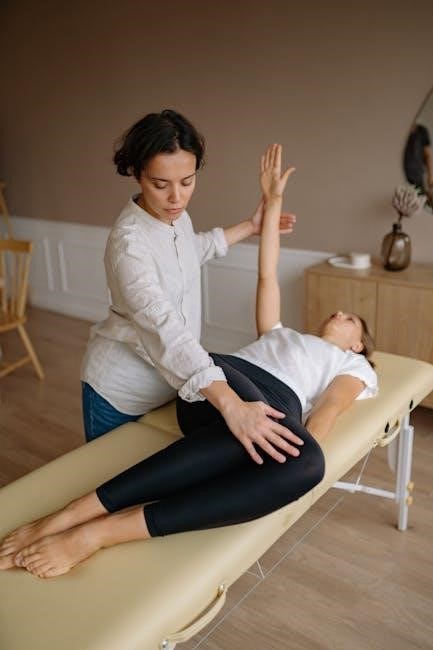
Troubleshooting and When to Seek Help
If exercises worsen symptoms, or persistent symptoms continue despite following brandt and daroff exercises pdf instructions, consult a healthcare professional immediately.
Don’t hesitate to seek guidance if dizziness intensifies or new neurological signs appear while performing the exercises detailed in a brandt and daroff exercises pdf.
Exercises Worsening Symptoms
If Brandt-Daroff exercises, as outlined in a brandt and daroff exercises pdf guide, initially increase dizziness or nausea, it doesn’t automatically signify failure. A temporary increase is sometimes expected as otoliths shift. However, sustained or significantly worsened symptoms require immediate attention.
Stop the exercises and consult a healthcare professional. This escalation could indicate an incorrect diagnosis, a different vestibular issue, or that the exercises are unsuitable for your specific canalithiasis type.
Carefully review the brandt and daroff exercises pdf for proper technique; improper form can exacerbate symptoms. Don’t continue if you experience new neurological symptoms like blurred vision, slurred speech, or weakness alongside increased dizziness.
Persistent Symptoms Despite Exercises
If, after diligently following a brandt and daroff exercises pdf protocol for the recommended duration – typically several days or weeks – your vertigo persists, further investigation is crucial. Complete symptom resolution isn’t guaranteed, and alternative treatments may be necessary.
Revisit the brandt and daroff exercises pdf to confirm correct execution. Consider that BPPV can sometimes be complex, involving multiple canals or atypical presentations.
Consult a healthcare professional or vestibular therapist. They can reassess your condition, explore other maneuvers like the Epley or Semont, or recommend Vestibular Rehabilitation Therapy (VRT) for comprehensive management.
Consulting a Healthcare Professional
Seeking professional guidance is vital if self-treatment using a brandt and daroff exercises pdf proves ineffective or if symptoms worsen. A healthcare provider can accurately diagnose the specific type of BPPV you have, as exercises vary based on the affected canal.
They can perform diagnostic testing, such as the Dix-Hallpike maneuver, to confirm the diagnosis and rule out other potential causes of vertigo.
A therapist specializing in vestibular disorders can tailor a personalized rehabilitation plan, potentially combining Brandt-Daroff with other techniques for optimal results, ensuring safe and effective treatment beyond a standard brandt and daroff exercises pdf.
Resources and Further Information
Numerous online vestibular disorder resources and professional organizations offer support and information. Search for reliable brandt and daroff exercises pdf guides.
Recent research (as of 12/25/2025) continues to refine understanding of BPPV and exercise protocols.
Always verify PDF authenticity before use.
Online Vestibular Disorder Resources
Several reputable websites provide comprehensive information about vestibular disorders, including Benign Paroxysmal Positional Vertigo (BPPV) and the application of Brandt-Daroff exercises. The Vestibular Disorders Association (VEDA) is a leading resource, offering detailed explanations, patient stories, and downloadable materials, often including guidance related to brandt and daroff exercises pdf formats.
Many healthcare providers also link to helpful online resources from their websites. Searching for “vestibular rehabilitation” or “BPPV exercises” will yield numerous results. Be sure to critically evaluate the source, prioritizing information from medical professionals or established organizations. Look for sites that offer clear instructions and demonstrate an understanding of the underlying mechanisms of the exercises, as detailed in many brandt and daroff exercises pdf documents.
Remember to always consult with a healthcare professional for personalized advice and treatment plans.
Professional Organizations for Vestibular Disorders
Several professional organizations dedicate themselves to advancing the understanding and treatment of vestibular disorders, often providing resources related to exercises like Brandt-Daroff. The American Academy of Otolaryngology – Head and Neck Surgery (AAO-HNS) offers information for both professionals and patients, potentially linking to guidelines or materials concerning brandt and daroff exercises pdf protocols.
The Association of Academic Physiatrists also supports research and education in vestibular rehabilitation. These organizations frequently host conferences and publish research findings that inform best practices. Searching their websites may reveal access to professional resources or links to patient-friendly materials, including those detailing brandt and daroff exercises pdf instructions.
Connecting with these organizations can provide access to the latest advancements in vestibular care.
Latest Research on Brandt-Daroff Exercises (as of 12/25/2025)
Recent studies (as of December 25, 2025) continue to validate Brandt-Daroff Exercises as an effective, accessible treatment for Posterior Canal Benign Paroxysmal Positional Vertigo (BPPV). Research highlights the importance of correct execution, often detailed in brandt and daroff exercises pdf guides, for optimal outcomes. Comparisons with maneuvers like Epley are ongoing, assessing long-term efficacy.
Modified Brandt-Daroff protocols, explored in several publications, demonstrate potential benefits for specific canalithiasis types. Accessing updated research via PubMed or Google Scholar can reveal the latest findings. Many studies emphasize the role of central compensation, a principle explained within comprehensive brandt and daroff exercises pdf resources.
Further investigation focuses on personalized exercise regimens.